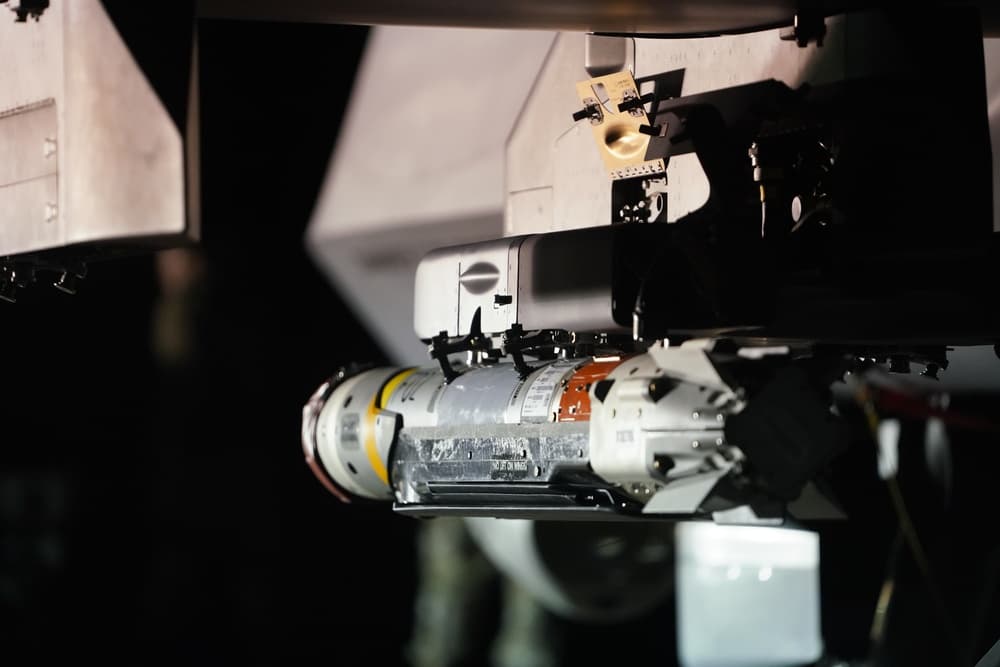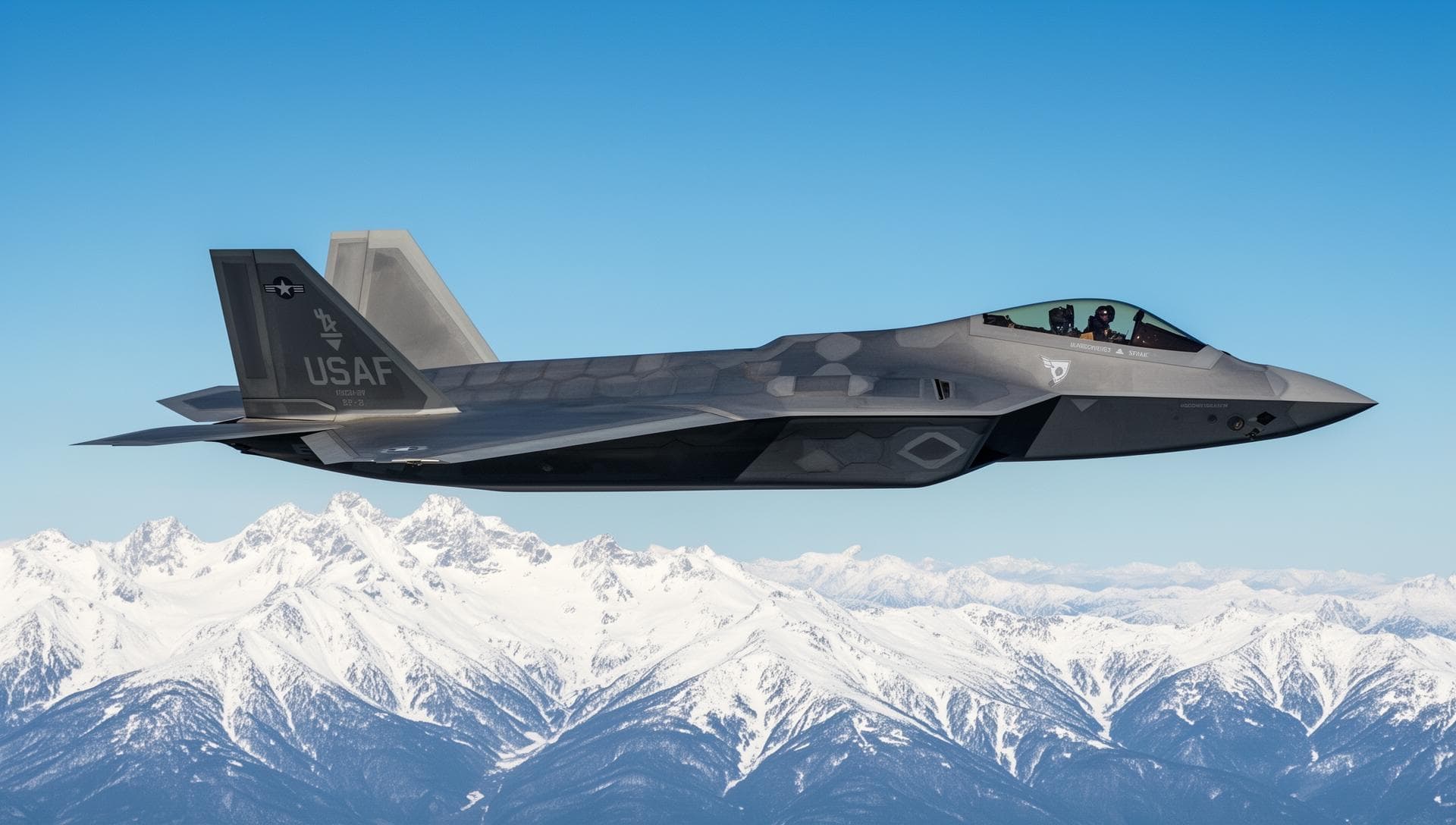
The F-22 Raptor and Su-57 Felon represent the pinnacle of American and Russian fighter aviation: two fifth-generation aircraft designed to dominate the skies through stealth, advanced sensors, and unprecedented performance. They are frequently compared as rivals, yet comprehensive analysis requires acknowledging fundamental limitations: much about both aircraft remains classified, their operational histories differ vastly in scope, and they reflect different strategic priorities shaped by different industrial and doctrinal contexts.
The F-22 entered service in 2005 as the world's first operational fifth-generation fighter, designed during the Cold War's twilight to ensure American air dominance for decades. The Su-57, initially designated PAK FA and later T-50, began development in the 2000s as Russia's answer to American stealth programs, entering limited service only in 2020. This timing difference alone means one aircraft has accumulated two decades of operational refinement while the other is still maturing.
This article provides a comprehensive, doctrine-driven comparison of the F-22 and Su-57 based on publicly available information. We examine design philosophy, stealth approach, sensor integration, kinematics, weapons employment, and operational maturity, focusing on what we can reasonably assess rather than speculation about classified capabilities.
Critically, this comparison does not declare a universal winner. Air combat outcomes depend on specific circumstances, training, support infrastructure, and the broader campaign context. Both aircraft reflect intelligent responses to their nations' strategic requirements and industrial capabilities.
At a Glance: Quick Verdict
F-22 Raptor Strengths
- All-aspect stealth design
- Proven supercruise capability
- Mature sensor fusion
- Two decades of operational refinement
- Extensive training and exercise history
Su-57 Felon Strengths
- Extreme maneuverability emphasis
- Multirole flexibility by design
- Advanced engine development path
- Infrared search and track integration
- Potential for rapid capability growth
The F-22 represents a mature, proven platform optimized for air dominance through stealth and first-look capability.
The Su-57 represents an evolving platform balancing stealth with traditional Russian fighter strengths in maneuverability and flexibility.
Design Philosophy: Two Paths to Fifth Generation
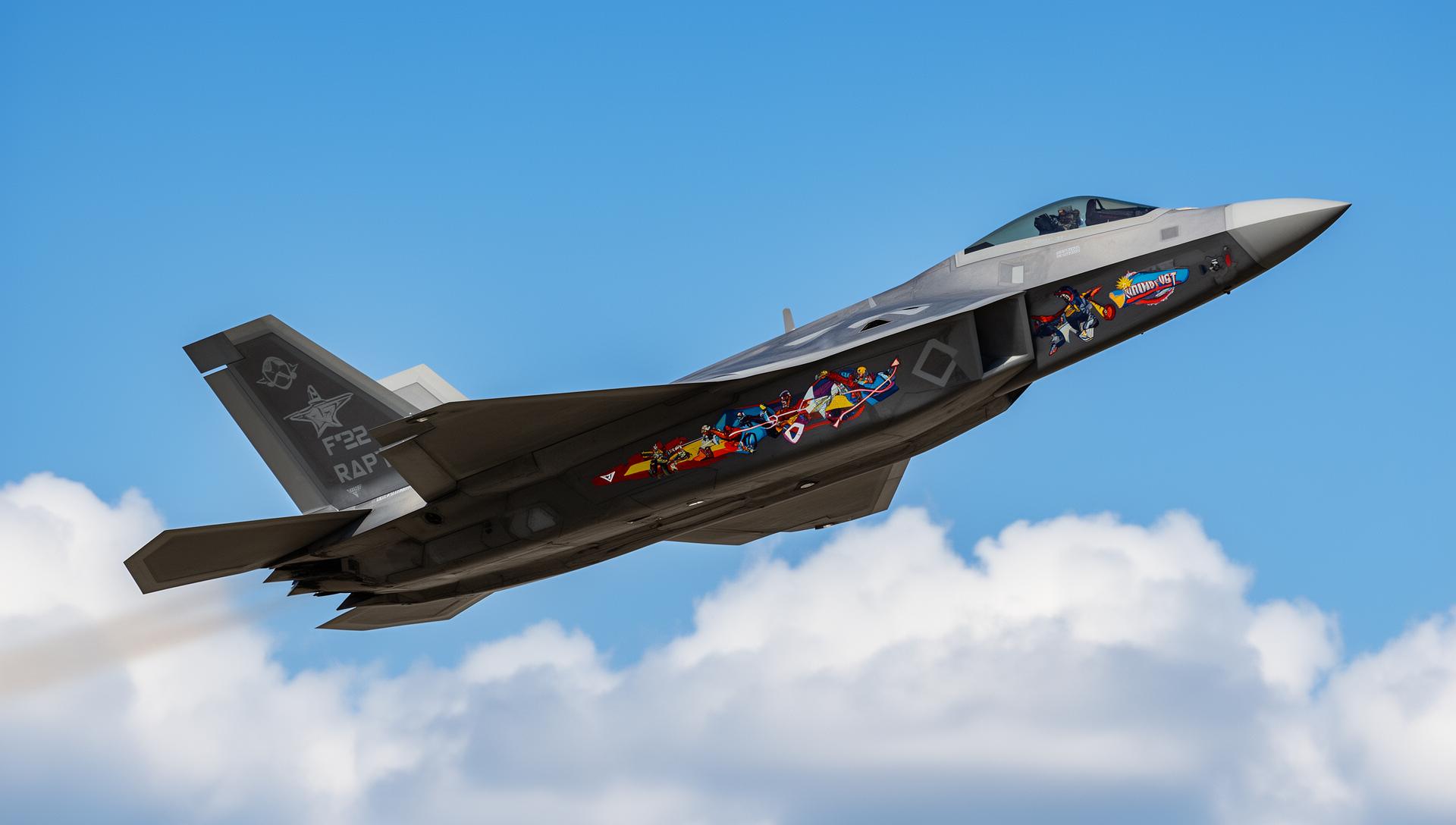
F-22 Design Philosophy: Air Dominance Through Stealth
The F-22 Raptor emerged from the Advanced Tactical Fighter (ATF) program launched in 1981, during a period when American defense planners anticipated facing advanced Soviet fighters in contested European airspace. The program's requirements were demanding: the new fighter must defeat all existing and projected threats while operating in environments saturated with surface-to-air missiles and electronic warfare.
Lockheed Martin's design philosophy centered on first-look, first-shot, first-kill, the ability to detect and engage enemy aircraft before being detected themselves. This required an unprecedented combination of capabilities:
- All-aspect stealth: Unlike previous low-observable designs that prioritized frontal aspect, the F-22 was engineered for reduced signature from all angles, allowing greater tactical flexibility
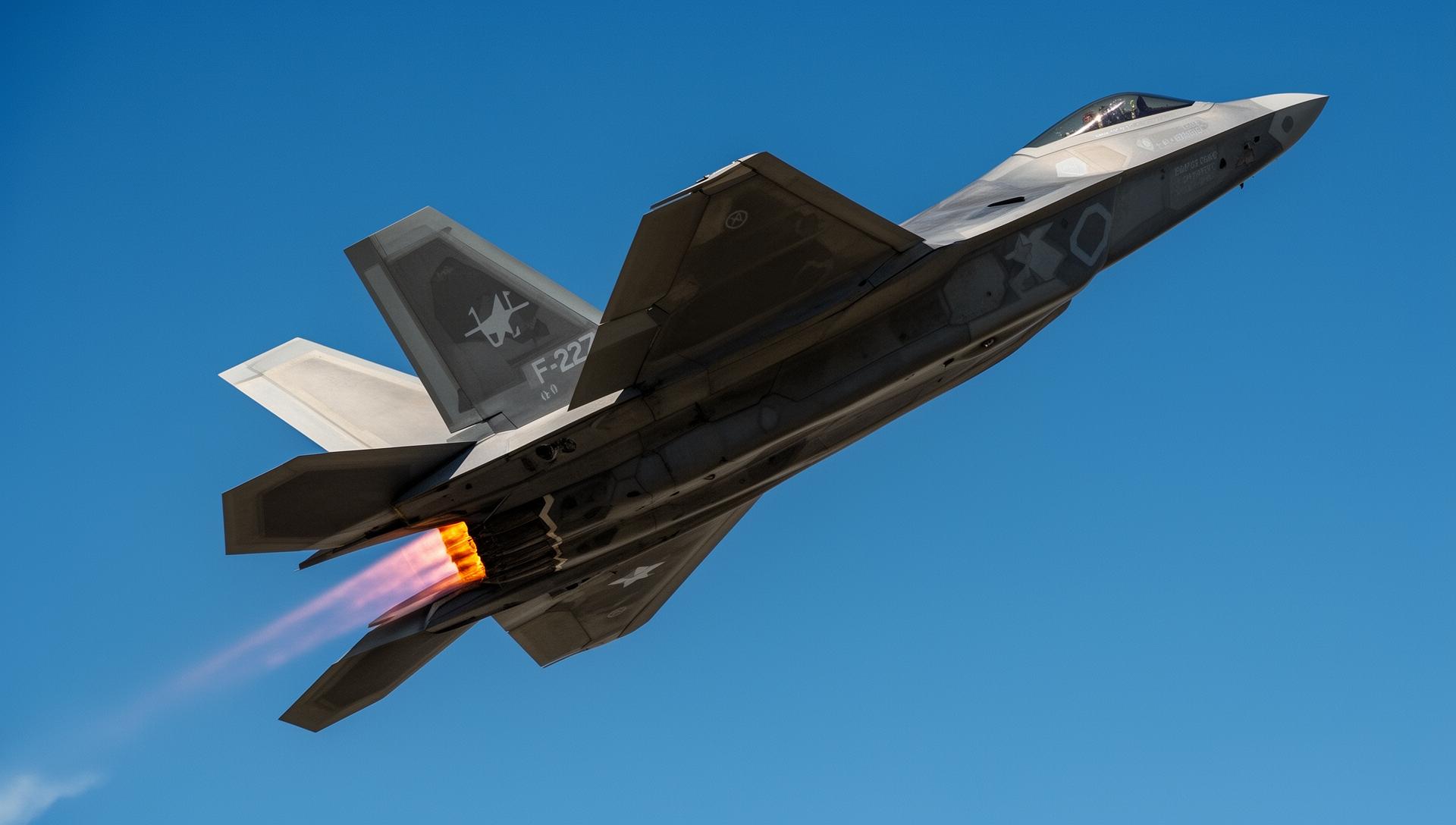
- Supercruise: The ability to sustain supersonic flight without afterburner, extending range and reducing infrared signature while maintaining speed advantages
- Integrated avionics: Sensor fusion that combines radar, electronic warfare, and communication data into a unified tactical picture
- Thrust vectoring: Two-dimensional nozzles providing enhanced maneuverability, particularly at high angles of attack
The F-22 was explicitly designed as an air superiority fighter first. While it has ground attack capability, the aircraft's entire design prioritizes the air-to-air mission. Every aspect, from the carefully aligned surface edges to the internal weapons bays, serves the goal of achieving and maintaining air dominance in the most demanding threat environments.
This specialization came at a cost. The F-22 is expensive to build and maintain, and its stealth coatings require intensive care. The decision not to export the aircraft means the entire production run of 195 aircraft must absorb all development costs, making each unit exceptionally valuable and irreplaceable once lost.
Su-57 Design Philosophy: Balancing Stealth with Russian Traditions
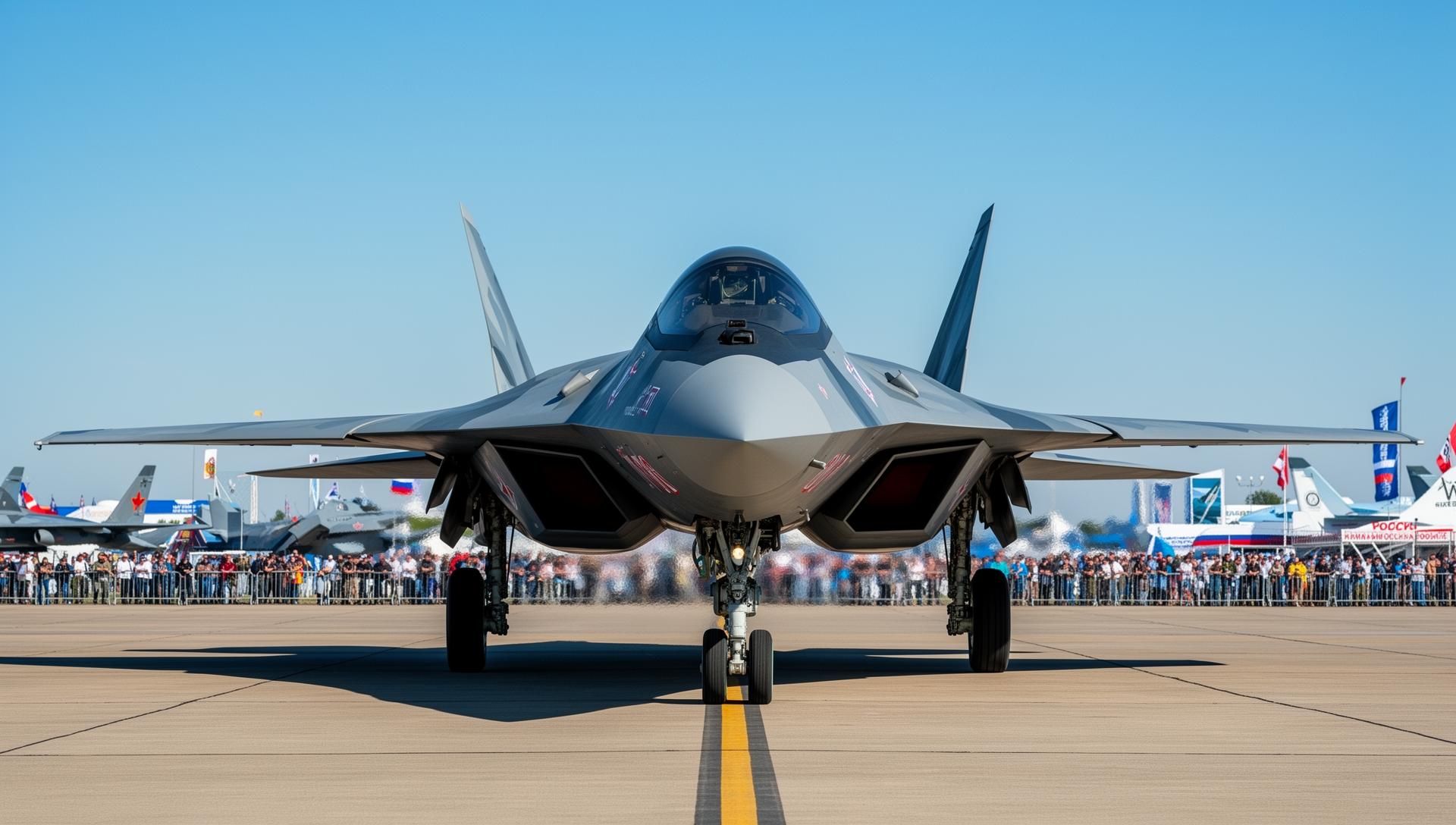
The Su-57 represents Russia's first true fifth-generation fighter, but its development occurred under vastly different circumstances than the F-22. The program began in earnest after the Cold War's end, during a period of severe economic constraints that shaped both its timeline and its design priorities.
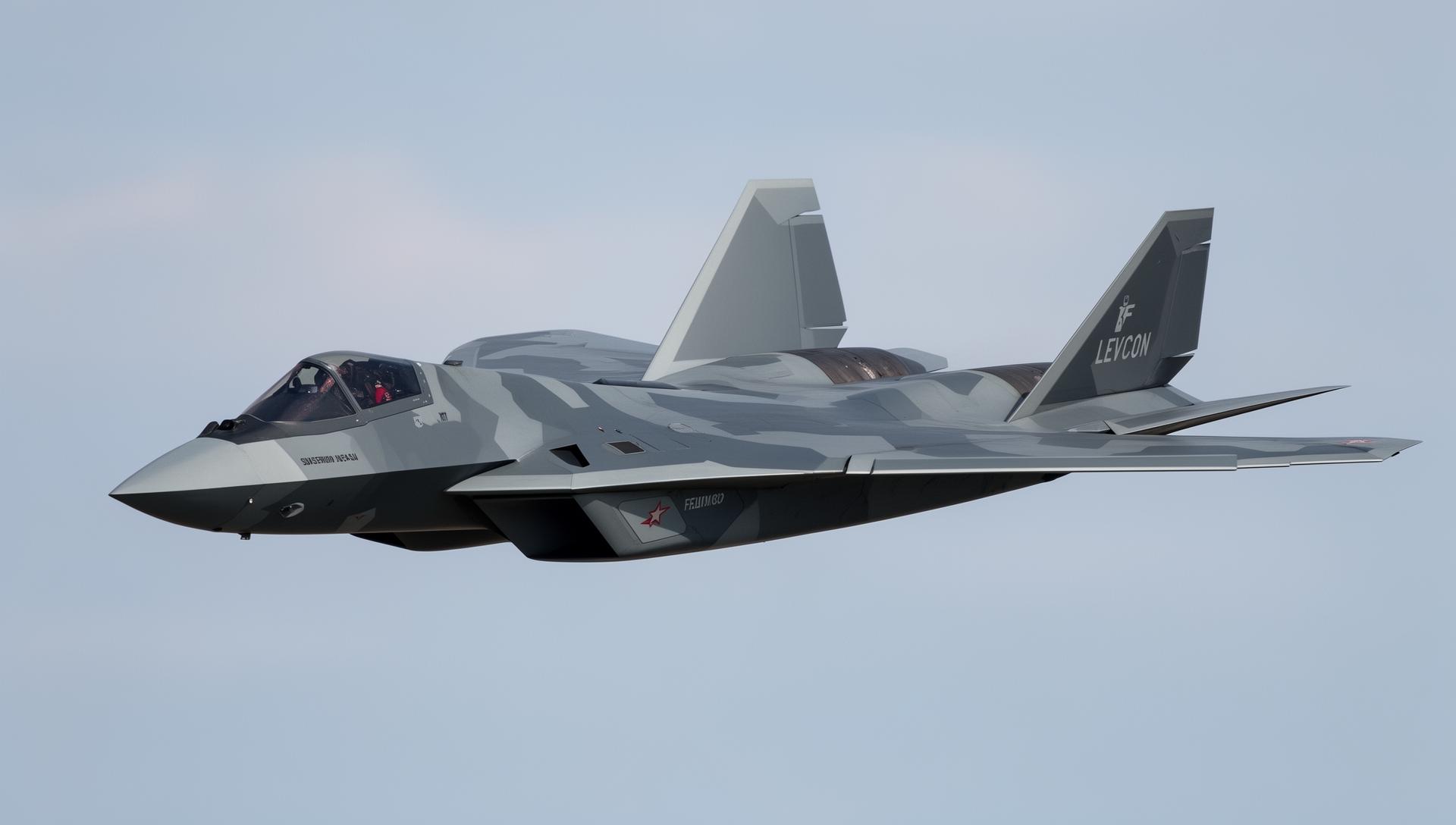
Russian designers approached the fifth-generation challenge differently. Rather than pursuing all-aspect stealth as the primary design driver, the Su-57 appears optimized for frontal-aspect signature reduction while retaining emphasis on traditional Russian fighter strengths:
- Extreme maneuverability: Three-dimensional thrust vectoring and aerodynamic design prioritize agility across the flight envelope
- Multirole capability: Unlike the F-22's air superiority focus, the Su-57 was designed from the start for both air-to-air and air-to-ground missions
- Sensor diversity: Integration of multiple radar arrays, infrared search and track (IRST), and electronic warfare systems
- Evolutionary development: The platform is designed to accommodate significant capability upgrades over its lifetime, including next-generation engines
The Su-57's design choices reflect Russian tactical doctrine, which has traditionally emphasized maneuverability and the close-range fight. Russian air combat theory argues that engagements frequently collapse to visual range, where aircraft handling matters more than stealth. Whether this assumption remains valid against modern Western capabilities is debatable.
Economic reality also shaped the Su-57. Russia cannot match American defense spending, so the aircraft was designed for greater affordability and easier maintenance than a pure stealth-optimized platform would require. Some Western analysts interpret design compromises (such as round-section engine nacelles that increase radar reflection) as evidence of manufacturing constraints rather than deliberate choices.
Stealth, Signature, and Detection
Stealth is perhaps the most discussed, and most misunderstood, aspect of fifth-generation fighters. Both the F-22 and Su-57 incorporate low-observable technologies, but they approach signature management differently, reflecting their distinct design philosophies.
Understanding Radar Cross Section
An aircraft's radar cross section (RCS) determines how far away radar can detect it. Reducing RCS doesn't make an aircraft invisible; it reduces the range at which detection occurs. This has profound tactical implications: an aircraft detected at 50 kilometers has far more options than one detected at 200 kilometers.
The F-22 was designed for minimal RCS from all aspects. Its surfaces are carefully angled to deflect radar energy away from receivers. Edges are aligned to reduce the number of scattering angles. Internal weapons carriage eliminates the large RCS contribution from external stores. Special coatings absorb radar energy. The result is an aircraft that multiple sources describe as having an RCS comparable to a small bird or marble from certain aspects, though exact figures remain classified.
The Su-57 incorporates stealth features but appears to prioritize frontal-aspect reduction over all-aspect stealth. Its leading edges are swept and aligned, and it carries weapons internally. However, features like the visible gaps between moving surfaces, round engine nacelles, and the engine compressor faces (visible from certain angles) suggest a higher RCS than the F-22, particularly from side and rear aspects.
Infrared Signature Considerations
Radar is not the only detection method. Infrared search and track (IRST) systems detect heat emissions from aircraft engines and airframes. Both aircraft produce significant heat, particularly during afterburner use. The F-22's supercruise capability allows sustained supersonic flight without afterburner, reducing infrared signature during high-speed operations. The Su-57's planned second-generation engines should eventually provide similar capability.
What Detection Differences Mean Tactically
The practical impact of stealth is measured in engagement timeline compression. If an F-22's lower RCS reduces detection range by half, the opposing pilot has half the time to react, identify, track, and engage. This advantage compounds: the F-22 may complete its engagement sequence before the enemy begins theirs.
Whether this advantage proves decisive depends on the specific threat environment, electronic warfare conditions, and whether the engagement remains beyond visual range. The Su-57's designers may be betting that many engagements will reach visual range, where stealth differences matter less and maneuverability matters more.
Detection Timeline: Stealth Impact (Conceptual)
Sensors, Avionics, and Information Flow
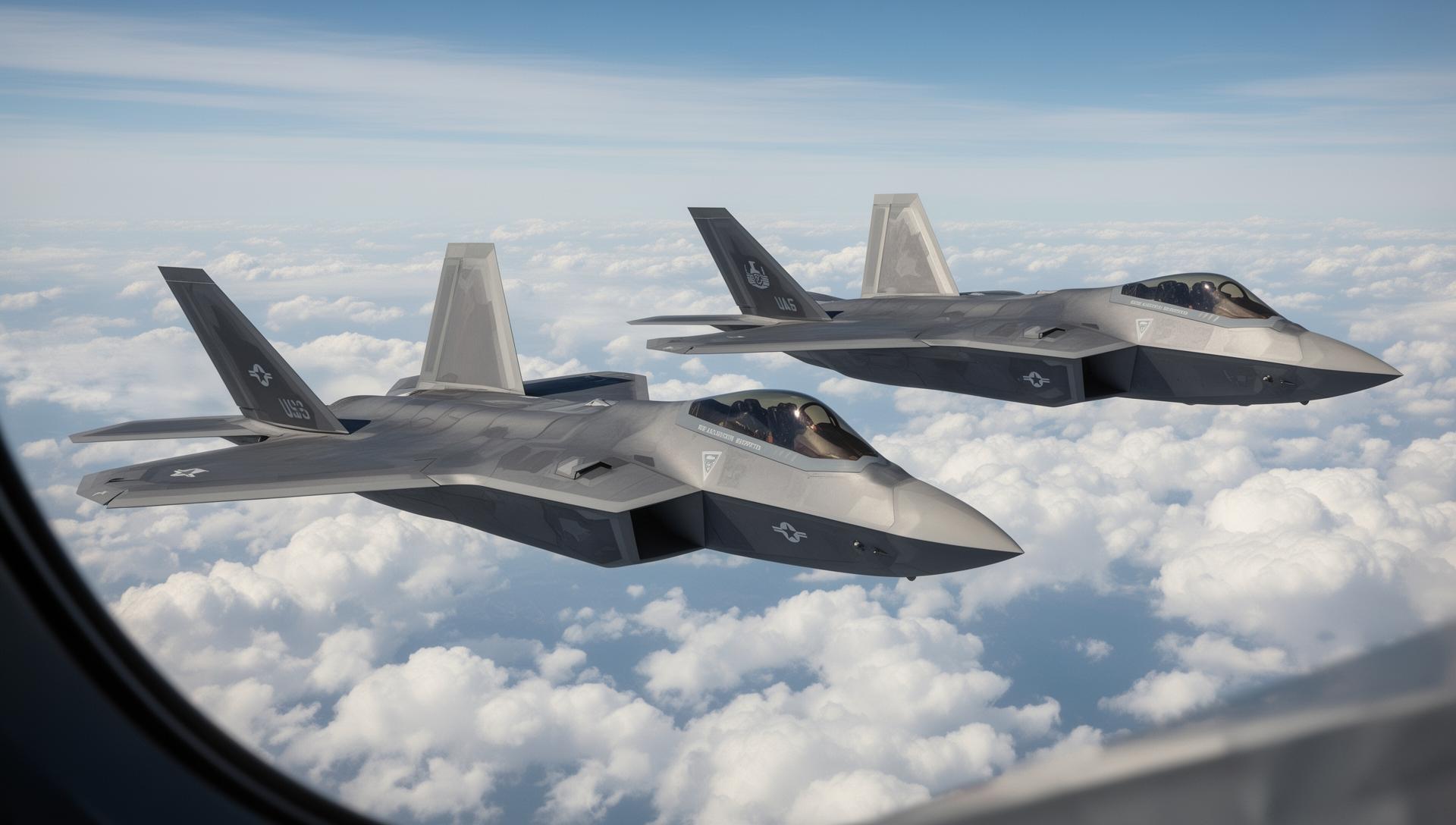
Modern air combat is often described as "a battle of information." The pilot who understands the tactical situation more completely and quickly holds a decisive advantage. Both the F-22 and Su-57 incorporate sophisticated sensor suites, but they differ in integration philosophy and maturity.
F-22 Sensor Suite and Fusion
The F-22's AN/APG-77 active electronically scanned array (AESA) radar was revolutionary at its introduction and remains highly capable. It can track multiple targets simultaneously, operate in low-probability-of-intercept modes to reduce detection, and function as an electronic warfare system. The radar integrates with:
- ALR-94 Electronic Warfare Suite: Considered one of the most capable systems of its type, providing threat warning and offensive capabilities
- Communication/Navigation/Identification: Secure datalinks for networked operations
- Missile Launch Detection: Providing cueing for defensive maneuvering
The F-22's defining avionics characteristic is sensor fusion. Data from all sensors is automatically correlated and presented as a unified tactical picture. The pilot sees tracks, not sensor contacts; the system decides which contacts represent the same target and presents synthesized information. This dramatically reduces pilot workload and speeds decision-making.
Su-57 Sensor Suite and Philosophy
The Su-57's Sh121 system incorporates multiple radar arrays: the main N036 Byelka AESA radar in the nose, plus additional arrays on the wing leading edges and potentially elsewhere. This distributed approach provides improved coverage and some resistance to jamming.
Russian fighters have traditionally emphasized infrared search and track (IRST), and the Su-57 continues this tradition with the 101KS Atoll electro-optical system. IRST provides passive detection without emitting radar energy, making it valuable for locating stealth aircraft that are optimized against radar.
Less is publicly known about the Su-57's sensor fusion compared to the F-22. Russian avionics have historically been less integrated than Western equivalents, though the Su-57 reportedly achieves improved fusion. The system's maturity remains uncertain given the aircraft's limited operational service.
Pilot Workload and Information Management
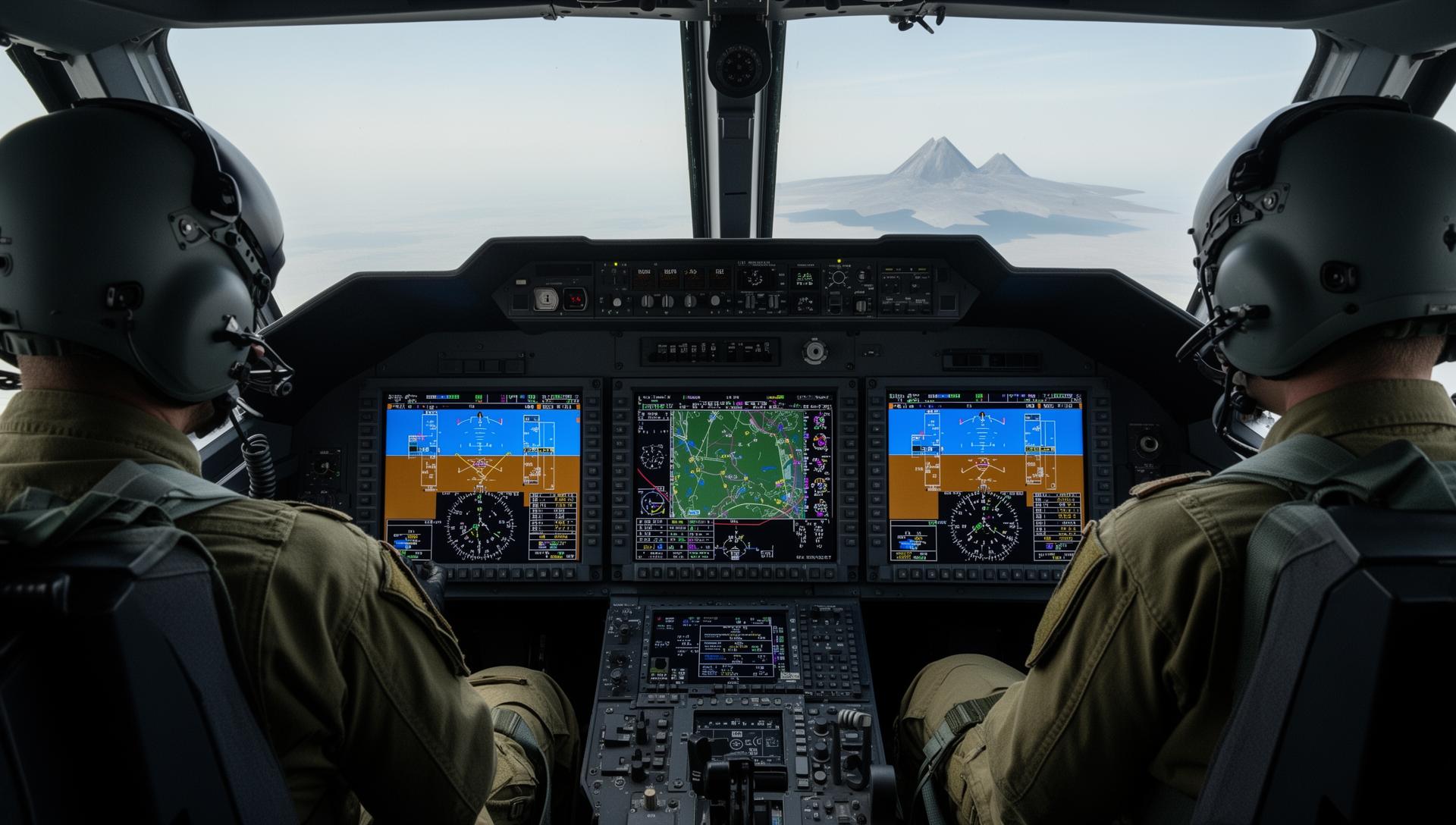
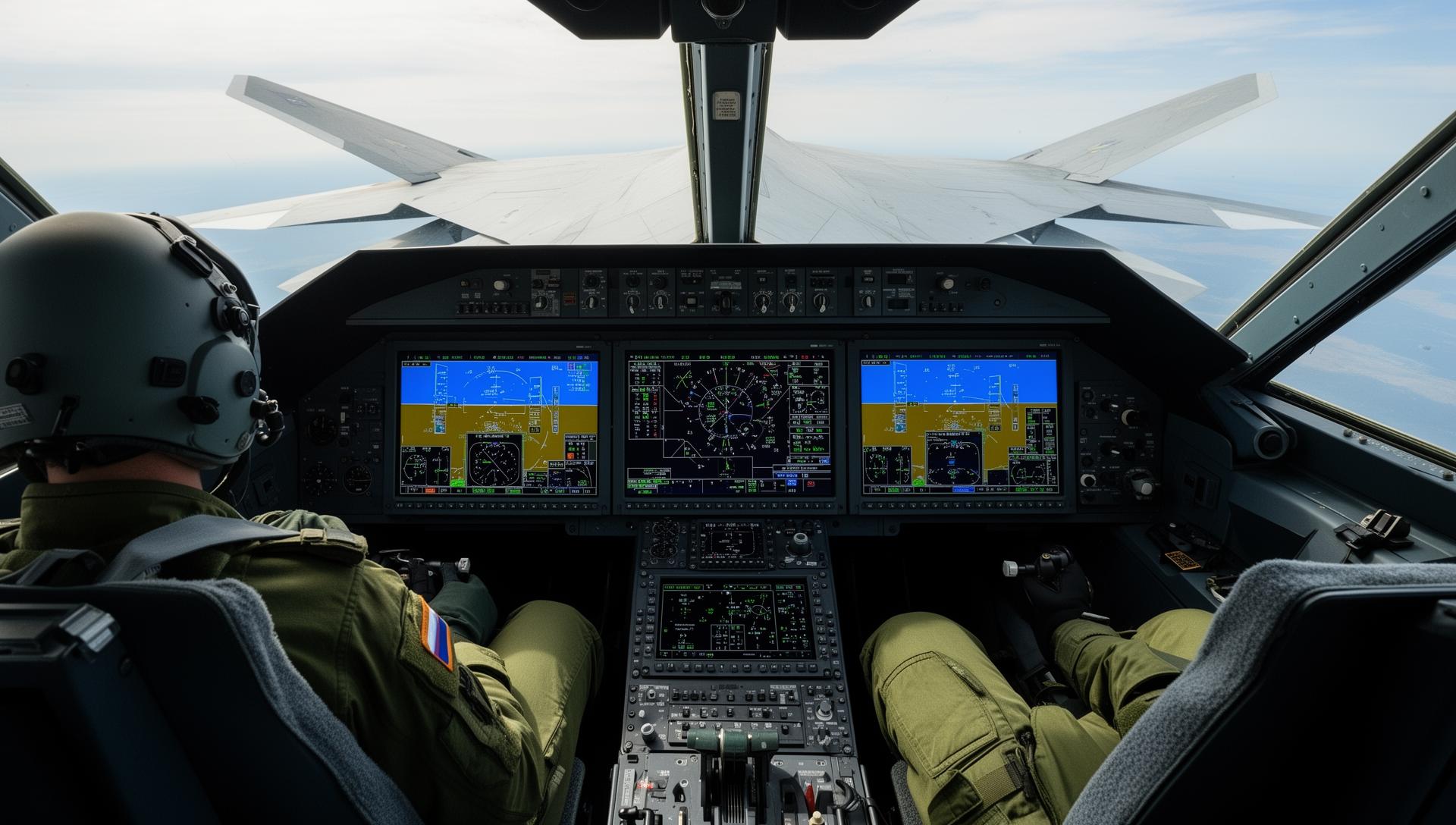
Both aircraft feature modern glass cockpits with large multifunction displays. The F-22's cockpit was designed to minimize pilot workload through automation, presenting the pilot with decisions rather than data processing tasks. The Su-57 appears to follow similar principles, though the extent of automation is unclear.
A key difference is operational experience. The F-22's avionics have been refined through two decades of flight hours, exercises, and software updates. Pilots and developers have identified and addressed countless integration issues. The Su-57 lacks this maturation history, meaning its systems, however advanced on paper, may not yet function as seamlessly in practice.
Kinematics, Speed, and Maneuverability
Both the F-22 and Su-57 are highly capable aircraft in terms of raw flight performance. However, they emphasize different aspects of the kinematic equation, reflecting different assumptions about how future air combat will unfold.
Supercruise: Sustained Supersonic Advantage
The F-22's Pratt & Whitney F119 engines provide reliable supercruise capability, the ability to sustain supersonic flight without fuel-hungry afterburner. This offers multiple advantages:
- Range extension: Supersonic flight without afterburner consumes less fuel
- Reduced infrared signature: Non-afterburning engines produce less heat
- Tactical flexibility: The ability to rapidly reposition while conserving fuel
- Energy state: Arriving at an engagement with speed already built provides options
The Su-57's current AL-41F1 engines provide limited supercruise capability. The planned second-generation Izdeliye 30 engines should substantially improve this, but they remain in development. Until these engines are widely fielded, the F-22 holds a significant supercruise advantage.
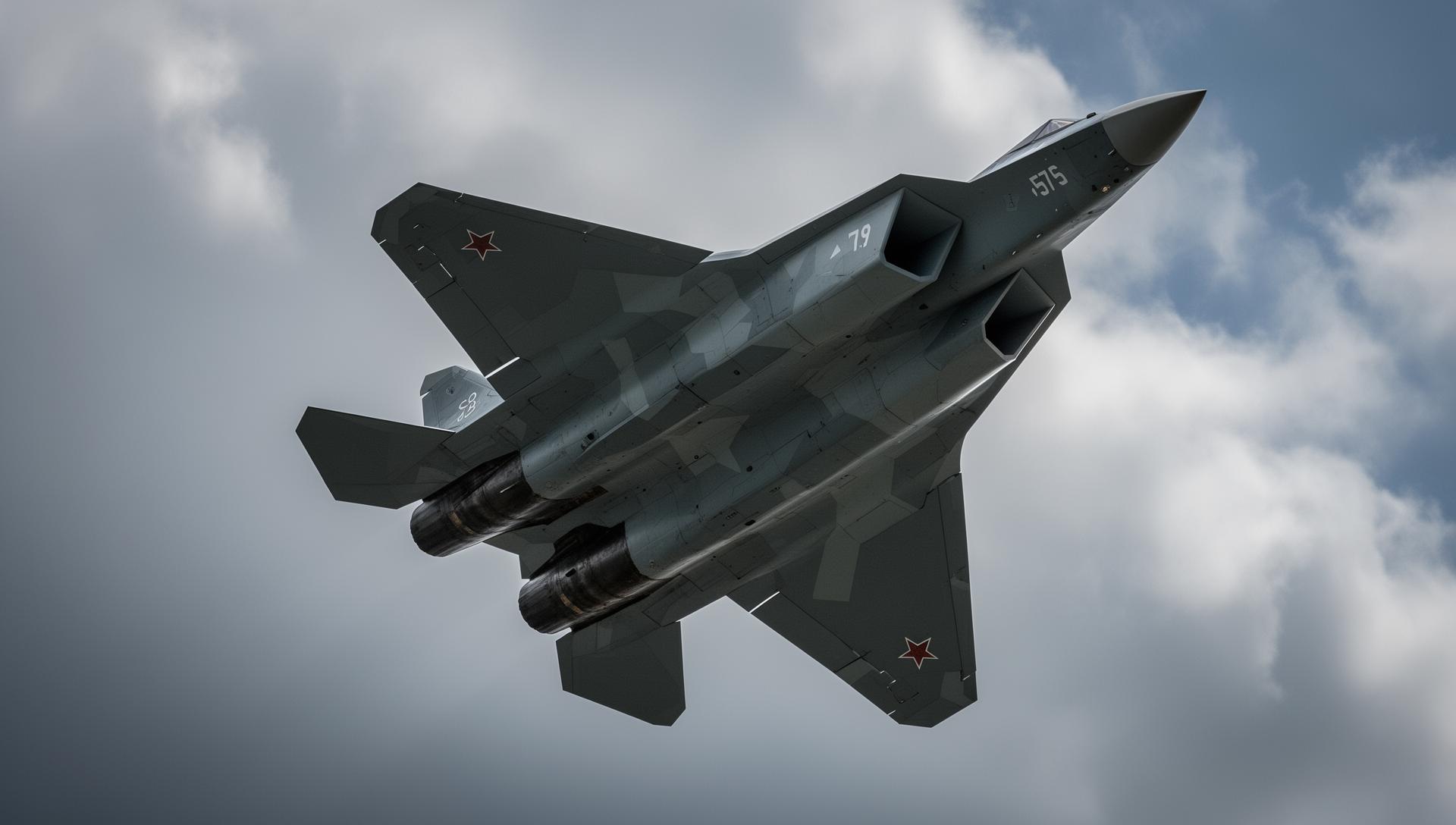
Maneuverability Philosophy
Russian fighter design has traditionally prioritized maneuverability, and the Su-57 continues this emphasis. The aircraft features:
- 3D thrust vectoring: Nozzles that vector in all axes for post-stall maneuvering
- LEVCON canards: Leading edge vortex controllers that enhance high-alpha performance
- Large wing area: Providing sustained turning capability
The F-22 also features thrust vectoring (2D, in the pitch axis only) and exceptional maneuverability. It can perform impressive post-stall maneuvers like the "falling leaf." However, American doctrine generally de-emphasizes close-range maneuvering in favor of beyond-visual-range engagements where the F-22's stealth and sensors provide advantages.
Does Maneuverability Still Matter?
This is a subject of significant debate. Western doctrine holds that modern missiles and sensors make traditional dogfighting increasingly irrelevant, arguing that engagements should be decided before reaching visual range. Russian doctrine counters that electronic warfare, missile failures, and ambiguous rules of engagement frequently collapse combat to visual range, where maneuverability matters.
The truth likely lies between these positions. Maneuverability provides options: defeating missiles, generating weapons employment opportunities, and disengaging. But expending energy in maneuvering also creates vulnerabilities. The Su-57's emphasis on maneuverability may prove invaluable in certain scenarios and unnecessary in others.
Weapons and Engagement Philosophy
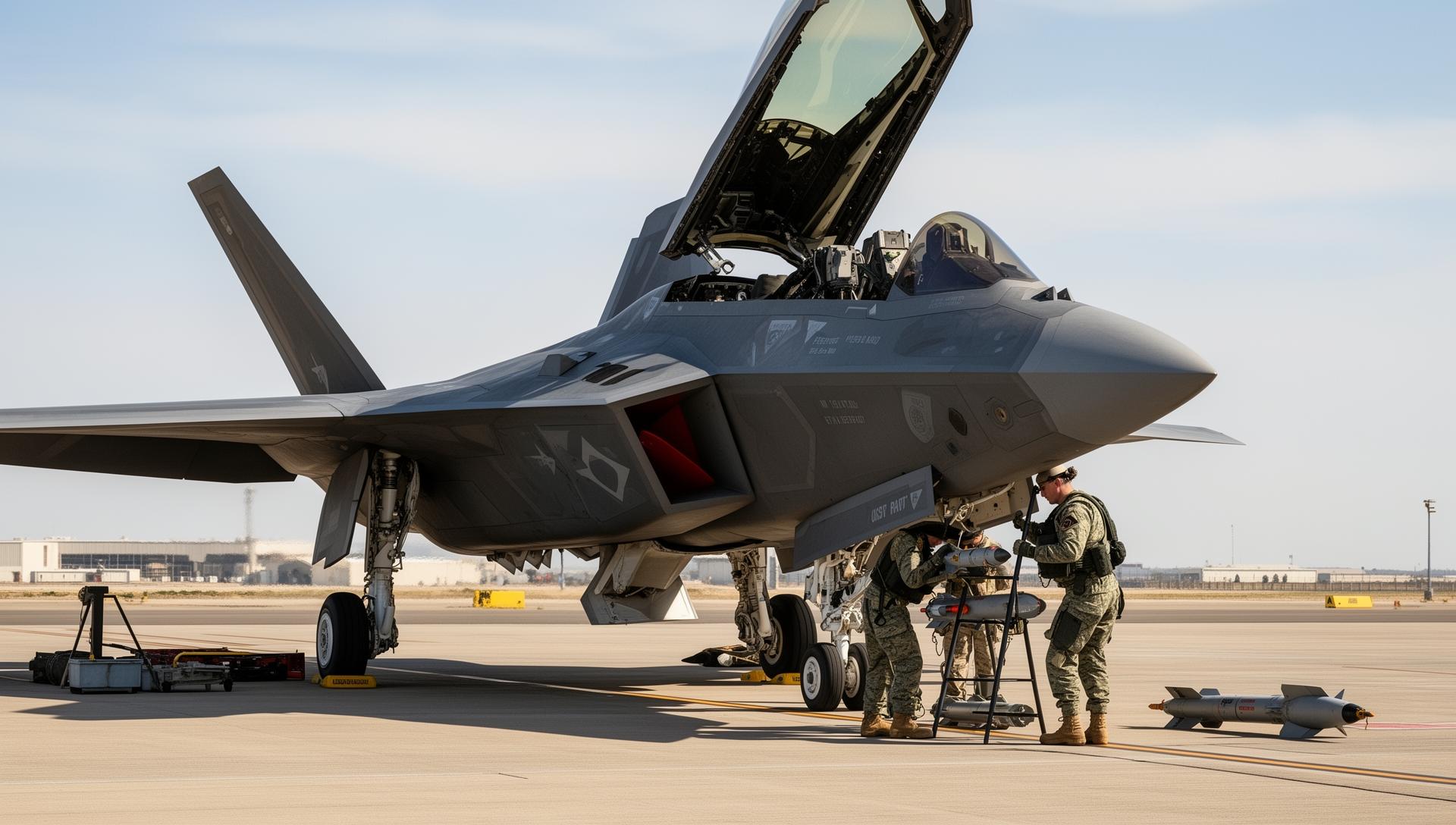
Both aircraft carry weapons internally to preserve stealth, with the option for external carriage when low-observability is not required. Their weapons integration reflects different engagement philosophies.
Internal Weapons Carriage
The F-22 carries six AIM-120 AMRAAM medium-range missiles internally, plus two AIM-9 Sidewinder short-range missiles in side bays. This provides significant beyond-visual-range capability while maintaining stealth. For strike missions, it can carry two 1,000-pound bombs internally.
The Su-57 features larger internal bays capable of carrying a variety of Russian air-to-air and air-to-ground weapons. Reports suggest it can carry six medium-range missiles internally, potentially including very long-range types like the R-37M.
Beyond-Visual-Range Emphasis
Both aircraft are optimized for beyond-visual-range (BVR) combat, where radar-guided missiles engage targets detected by onboard sensors or networked systems. The F-22's sensor fusion and stealth provide advantages in the detect-first, shoot-first paradigm that dominates BVR doctrine.
Russia has invested heavily in very-long-range missiles that may offset some of the F-22's advantages. If a Su-57 can detect an F-22 (using IRST, networked sensors, or reduced-aspect detection) and launch a long-range missile, it creates a threatening geometry even against a stealthier opponent.
Close-Range Considerations
If combat reaches visual range, both aircraft carry short-range infrared missiles and cannon. The Su-57's maneuverability advantages would become more relevant in this regime. However, both aircraft are designed to avoid this scenario when possible: the F-22 through maintaining engagement distance, the Su-57 by ideally engaging before American aircraft can bring their advantages to bear.
The Kill Chain Breakdown
To understand how these aircraft might perform against each other, it's useful to examine the air combat kill chain: the sequence of detect, track, target, engage, and survive that determines engagement outcomes. Each step involves different capabilities and creates different advantages.
Kill Chain Flow Diagram (Conceptual)
1. Detect
Detection is the foundational step. The aircraft that detects first gains the initiative, enabling it to maneuver, prepare weapons, and potentially engage before the opponent knows it's in danger.
F-22 Advantage: The F-22's lower radar cross section means it can likely approach closer before detection than the Su-57. Its sensors can search while emitting less detectable energy. In most scenarios against radar-based detection, the F-22 should detect first.
Su-57 Countermeasures: The Su-57's IRST provides a passive detection mode that doesn't require radar emissions. Against a supercruising F-22 (which generates heat), IRST may provide detection at significant ranges. Networked detection from other platforms could also cue the Su-57 to threats.
Uncertainty: Actual detection ranges depend on specific radar and sensor modes, atmospheric conditions, electronic warfare, and platform configurations, none of which are publicly known in detail.
2. Track
Detecting a target is insufficient; the system must maintain track quality sufficient for weapons employment. This requires correlating sensor data over time and distinguishing the target from clutter or countermeasures.
F-22 Advantage: The F-22's mature sensor fusion excels at maintaining quality tracks. Its systems have been refined over two decades to handle complex tracking scenarios. The aircraft can likely maintain weapons-quality tracks on stealthy targets at longer ranges.
Su-57 Position: The Su-57's distributed radar arrays and IRST combination should provide robust tracking, but the system's maturity is uncertain. Russian avionics have historically struggled with the data fusion challenge that the F-22 handles well.
3. Target
Targeting involves generating a weapons-quality solution, meaning sufficient information confidence to launch a missile with reasonable probability of kill. This depends on track quality, missile capability, and engagement geometry.
Both aircraft carry capable missiles. The F-22's AIM-120D represents continuous evolution of a proven design. The Su-57's R-77 variants and potentially the very-long-range R-37M offer different approaches. Targeting effectiveness depends on factors including:
- Track accuracy and update rate
- Missile guidance and seeker capability
- Electronic warfare environment
- Target maneuvering and countermeasures
4. Engage
Engagement involves missile launch and guidance. Both aircraft can launch missiles and continue tracking targets. The F-22's stealth allows it to potentially guide missiles while remaining undetected. The Su-57's long-range missile options may allow it to engage from beyond the effective range of return fire.
Multiple-missile engagements, electronic warfare, and cooperative tactics all complicate simple comparisons. Real engagements would involve formations, not single aircraft.
5. Survive
If an adversary launches missiles, survival depends on awareness, countermeasures, and maneuvering. Both aircraft carry electronic countermeasures and expendables (chaff and flares). Both can perform defensive maneuvering.
F-22 Philosophy: Avoid detection to avoid engagement. If engaged, use stealth to complicate enemy missile guidance. Maneuver if necessary.
Su-57 Philosophy: Use maneuverability and countermeasures aggressively. The aircraft's agility may allow it to defeat missiles kinetically (outmaneuvering them) more effectively than less agile aircraft.
Operational Maturity and Real-World Use
The difference in operational experience between these aircraft cannot be overstated. The F-22 has twenty years of active service; the Su-57 has four years of limited operations.
F-22 Operational History
The F-22 achieved initial operational capability in 2005. Since then, it has:
- Accumulated tens of thousands of flight hours across the fleet
- Participated in numerous large-force exercises, including Red Flag
- Intercepted Russian aircraft near Alaskan airspace on multiple occasions
- Deployed to the Middle East and Pacific theaters
- Conducted combat strikes against ISIS targets in Syria (2014 onward)
This operational experience has enabled extensive software refinement, identification and correction of maintenance challenges, development of tactics, and confidence in the platform's actual (not theoretical) capabilities.
Su-57 Development Status
The Su-57's development has been protracted due to funding constraints, technical challenges, and industrial limitations. The first prototype flew in 2010, but serial production only began around 2019. As of 2024, Russia operates a small number of aircraft, estimated at fewer than 30.
Limited operations in Syria have provided some real-world testing, but the Su-57 lacks the extensive exercise and deployment history that refines operational platforms. Its avionics, sensors, and maintenance procedures remain less proven than the F-22's.
Why Maturity Matters
Advanced fighters are immensely complex systems. Their actual performance often differs from design specifications. The F-22's two decades of operation have revealed and addressed countless issues, from oxygen system problems to software glitches to maintenance procedures. The Su-57 will face similar challenges as it matures, meaning its current capabilities may differ from its eventual potential.
Cost, Scale, and Sustainment Reality
Strategic effectiveness depends not just on individual aircraft capability but on numbers, availability, and sustainability. Here the F-22 and Su-57 face very different realities.
Production Scale
The United States built 195 F-22s before terminating production in 2011. While this number is often criticized as insufficient, it represents a substantial fleet of proven, capable aircraft.
Russia has announced ambitious Su-57 production goals but has historically struggled to meet them. Current production rates appear to be in the single digits annually. Economic constraints, industrial capacity limitations, and competing priorities all restrict expansion.
Availability and Readiness
The F-22's stealth coatings and complex systems create maintenance challenges. Mission capability rates have historically been lower than desired, though the Air Force has worked to improve them. Nevertheless, the U.S. maintains substantial support infrastructure, spare parts inventories, and maintenance expertise.
The Su-57's reliability and availability in operational service remain unclear due to limited public information. Newer production aircraft benefit from lessons learned but lack the mature support infrastructure of established platforms.
Strategic Implications
In a prolonged conflict, the ability to generate sorties, repair damage, and replace losses matters enormously. The U.S. benefits from greater industrial capacity and deeper financial resources. However, the F-22's production line is closed, meaning losses cannot be replaced. Each aircraft represents an irreplaceable national asset.
Key Comparison Table
| Category | F-22 Raptor | Su-57 Felon | Why It Matters |
|---|---|---|---|
| Primary Mission | Air dominance | Multirole | Design priorities shape capability tradeoffs |
| Stealth Approach | All-aspect optimization | Frontal-aspect emphasis | Affects detectability from different angles |
| Sensor Integration | Mature fusion | Developing fusion | Determines information advantage quality |
| Maneuverability Philosophy | Capable, not emphasized | Core design priority | Different assumptions about combat ranges |
| Supercruise | Proven, reliable | Limited (current engines) | Affects range, signature, and positioning |
| Weapons Carriage | 6 AAM internal | 6 AAM internal (reported) | Similar capacity, different missile types |
| Operational Maturity | 20 years, combat-proven | 4 years, limited operations | Maturity reveals and resolves real-world issues |
| Production Numbers | 195 built, line closed | <30, slow production | Numbers matter in sustained operations |
| Doctrine Fit | Information dominance | Kinematic flexibility | Reflects different theories of air combat |
Download: F-22 vs Su-57 Stealth Fighter Comparison (PDF)
For quick reference, download our one-page stealth fighter comparison sheet. This print-ready resource includes a condensed comparison table, key capability assessments, and the "what actually decides modern air combat" checklist for evaluating fighter engagements.
F-22 vs Su-57: One-Page Comparison
Printable reference • Stealth fighter analysis • Public information only
Important: This comparison uses publicly available information only. Actual performance data is classified. Variant differences, upgrade packages, and operational context significantly affect real-world capability.
Frequently Asked Questions
Direct comparison is difficult due to limited public information about both aircraft's actual performance. The F-22's longer operational history and proven systems provide confidence in its capabilities, while the Su-57 remains less tested. Outcomes would depend heavily on specific engagement circumstances, pilot training, and supporting systems.
Would an F-22 defeat a Su-57 in combat?
Direct comparison is difficult due to limited public information about both aircraft's actual performance. The F-22's longer operational history and proven systems provide confidence in its capabilities, while the Su-57 remains less tested. Outcomes would depend heavily on specific engagement circumstances, pilot training, and supporting systems.
Is the Su-57 truly a stealth aircraft?
The Su-57 incorporates stealth features including internal weapons bays and radar-absorbing materials, but analysts generally consider it less optimized for all-aspect stealth than the F-22. Its design appears to prioritize frontal-aspect signature reduction while retaining kinematic performance.
Why doesn't the United States export the F-22?
The Obey Amendment (1998) prohibits F-22 exports to protect its classified technologies. The aircraft's stealth coatings, sensor fusion software, and electronic warfare capabilities are considered critical national security assets that could be compromised through foreign sales.
Does thrust vectoring make the Su-57 superior in a dogfight?
Thrust vectoring enhances post-stall maneuverability, which can be advantageous in close-range visual combat. However, modern air combat emphasizes beyond-visual-range engagements where detection and missile performance matter more than turning capability. The F-22 also has thrust vectoring.
How does pilot training affect outcomes between these aircraft?
Training is a significant force multiplier. The U.S. Air Force operates one of the world's most extensive combat training programs, including realistic adversary exercises. Russian pilots receive solid training but with fewer flight hours and less access to large-scale exercises against varied threats.
Is stealth technology becoming obsolete?
Stealth remains highly valuable, though detection technologies continue advancing. Low-observability doesn't provide invisibility but reduces detection range and complicates targeting. Even partial stealth advantages compound over an engagement sequence, affecting who detects, tracks, and shoots first.
How many F-22s and Su-57s exist?
The U.S. produced 195 F-22s, with approximately 180 currently operational. Russia has built a small number of Su-57s (estimated under 30 as of 2024), with production scaling slowly due to economic and industrial constraints.
Why did the U.S. stop producing the F-22?
Production ended in 2011 due to high costs (over $300 million per aircraft including development), the perceived lack of peer threats at the time, and the shift toward the more versatile F-35 program. The decision remains controversial given renewed great-power competition.
Has either aircraft seen combat?
The F-22 has conducted air-to-ground strikes against ISIS targets in Syria starting in 2014. The Su-57 reportedly conducted limited operations in Syria for testing purposes. Neither has engaged enemy aircraft in air-to-air combat.
Which has better sensors?
The F-22's AN/APG-77 radar and integrated sensor suite are considered highly capable with extensive operational refinement. The Su-57's Sh121 radar system is advanced but less mature. The F-22's sensor fusion is regarded as more sophisticated, though specific capabilities remain classified.
Can the Su-57 supercruise like the F-22?
The Su-57's planned production engines should enable supercruise capability, though current aircraft use interim engines with limited supercruise performance. The F-22 has demonstrated sustained supersonic flight without afterburner since entering service.
Which is more maneuverable?
Both aircraft feature thrust vectoring and excellent maneuverability. The Su-57's design emphasizes aerodynamic agility and may have advantages in certain flight regimes. However, comparing overall maneuverability is difficult without access to classified performance data.
Final Verdict: Why This Comparison Defies Simple Answers
The F-22 Raptor and Su-57 Felon represent different nations' answers to the fifth-generation fighter challenge, shaped by different resources, industrial bases, threat perceptions, and doctrinal traditions. Declaring one "better" than the other without specifying context reveals more about the analyst's assumptions than about the aircraft themselves.
The F-22 excels as a mature, proven platform optimized for air dominance in contested environments. Its stealth, sensor fusion, and supercruise capability provide a potent first-look, first-shot advantage that has been refined over two decades. American pilots trust their aircraft because it has been tested exhaustively.
The Su-57 represents Russia's attempt to field competitive fifth-generation capability within realistic industrial and economic constraints. It emphasizes different strengths (maneuverability, multirole flexibility, sensor diversity) reflecting Russian doctrine's assumptions about how combat unfolds. Its potential remains partially unrealized due to limited maturity.
What actually decides air combat outcomes extends far beyond individual aircraft comparison:
- Training: The most capable aircraft flown by poorly trained pilots loses to lesser aircraft flown by experts
- Numbers: Quality advantages can be overwhelmed by quantity
- Supporting systems: AWACS, tankers, electronic warfare aircraft, and ground-based systems all affect outcomes
- Tactics: How aircraft are employed matters as much as their individual capabilities
- Maintenance: Aircraft that aren't available don't contribute to combat power
The F-22 and Su-57 will likely never meet in air-to-air combat - and if they did, the engagement would be decided by factors far beyond their specification sheets. What we can say is that both represent serious attempts to achieve air superiority in an era of advanced threats, and both merit respect as engineering achievements regardless of which approach ultimately proves more effective.
Continue Reading
- F-15 vs F-35: The Definitive Fighter Jet Comparison
- Coming Soon: F-22 vs F-35 - America's Fifth-Gen Fighters
- Coming Soon: Su-57 vs Su-35 - Russian Fighter Evolution
- Coming Soon: Stealth vs Maneuverability in Modern Air Combat