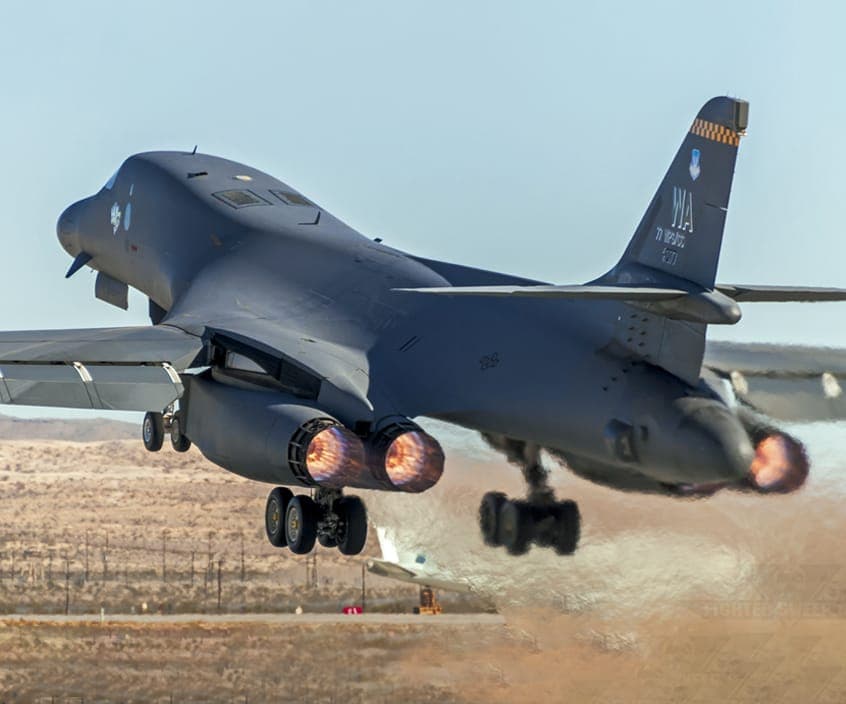
The B-1 Lancer and B-2 Spirit represent two different philosophies in strategic bomber design. The B-1 prioritizes speed and payload capacity, while the B-2 prioritizes stealth and penetration of defended airspace. Both serve crucial but distinct roles in America's bomber fleet.
B-1 Lancer: Speed and Payload

The B-1 Lancer entered service in 1986 as a supersonic bomber designed to penetrate Soviet air defenses at low altitude. Its variable-sweep wings can change position from 15 to 67.5 degrees, optimizing for either high-speed dash or fuel-efficient cruise.
B-1 Key Specifications
- Speed: Mach 1.25 (900+ mph)
- Payload: 75,000 pounds of ordnance
- Range: 5,900+ miles without refueling
- Crew: 4 (commander, copilot, two weapon systems officers)
- Engines: Four GE F101-GE-102 turbofans with afterburner
The B-1 can carry more weapons than any other American bomber. Its three internal weapons bays and external hardpoints allow it to deliver massive conventional payloads, including cruise missiles, precision-guided bombs, and cluster munitions.
B-2 Spirit: Stealth and Penetration
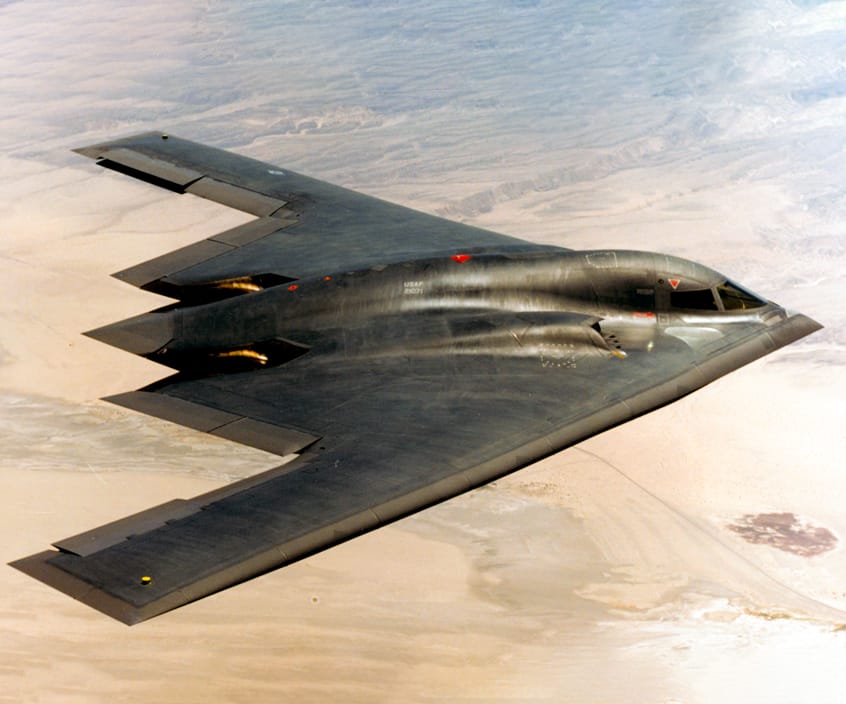
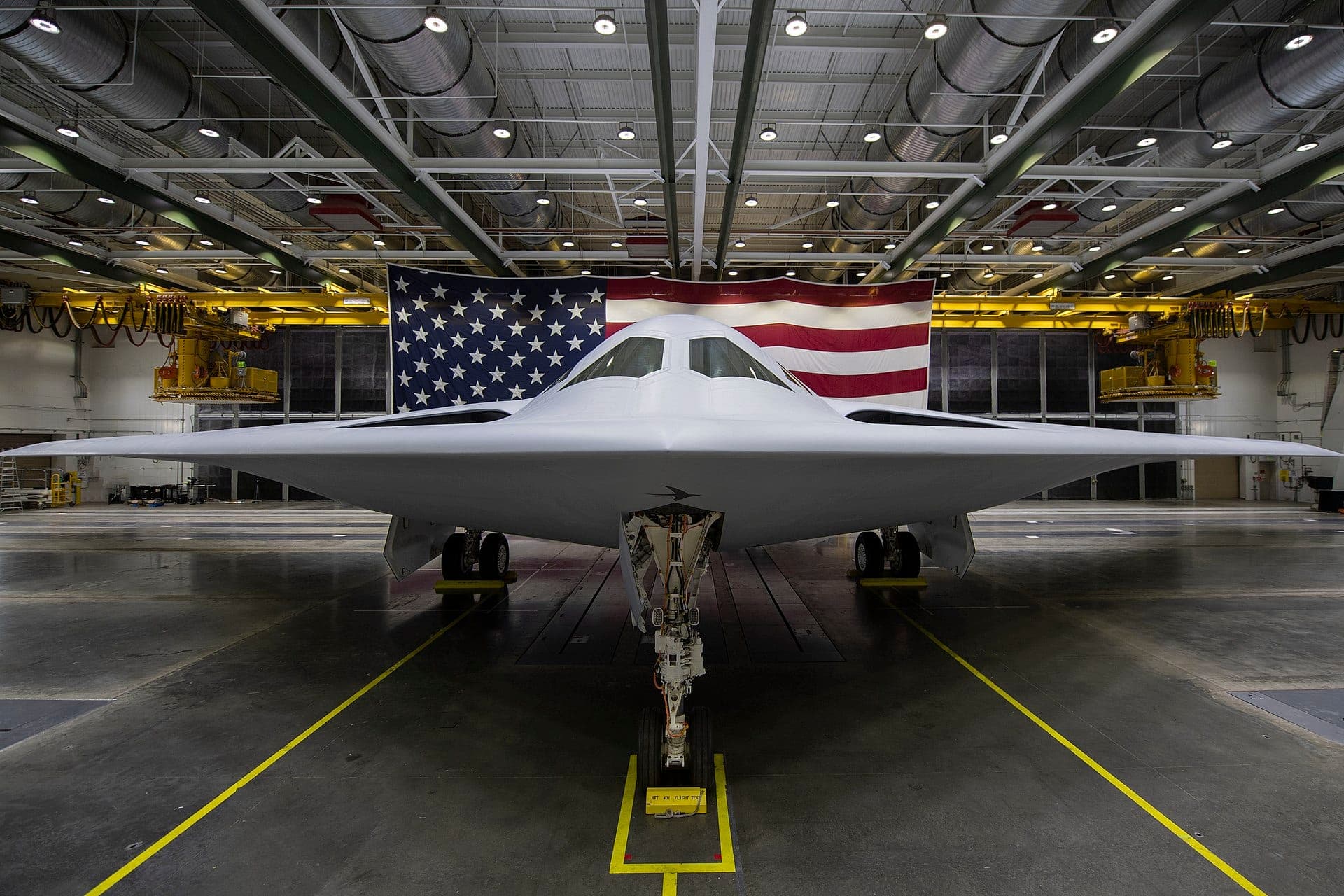
The B-2 Spirit entered service in 1997 as America's first operational stealth bomber. Its distinctive flying wing design and radar-absorbing materials make it nearly invisible to enemy air defenses, allowing it to penetrate the most heavily defended airspace.
B-2 Key Specifications
- Speed: Mach 0.95 (628 mph)
- Payload: 40,000 pounds of ordnance
- Range: 6,000+ miles without refueling
- Crew: 2 (pilot and mission commander)
- Engines: Four GE F118-GE-100 turbofans (non-afterburning)
The B-2 costs over $2 billion per aircraft, making it the most expensive military aircraft ever built. Only 21 were produced. Its stealth capabilities justify this cost for missions requiring penetration of sophisticated air defense networks.
Key Differences
- Primary Design Goal: B-1 emphasizes speed and payload; B-2 emphasizes stealth
- Top Speed: B-1 reaches Mach 1.25; B-2 limited to Mach 0.95
- Payload: B-1 carries 75,000 lbs; B-2 carries 40,000 lbs
- Unit Cost: B-1 costs ~$283 million; B-2 costs ~$2.1 billion
- Fleet Size: 45 B-1s remain active; 20 B-2s remain active
- Nuclear Role: B-1 is conventional-only; B-2 is nuclear-capable
Mission Roles
The B-1 excels at conventional strike missions requiring massive firepower delivery. It has been extensively used in Afghanistan, Iraq, and Syria, delivering more ordnance than any other American aircraft in recent conflicts.
The B-2 is reserved for high-value missions against defended targets. It conducted the opening strikes of operations in Kosovo, Afghanistan, Iraq, and Libya, destroying air defense systems and command centers.
Both bombers will eventually be replaced by the B-21 Raider, which combines stealth with conventional capability. Until then, the B-1 and B-2 complement each other as America's long-range strike force.