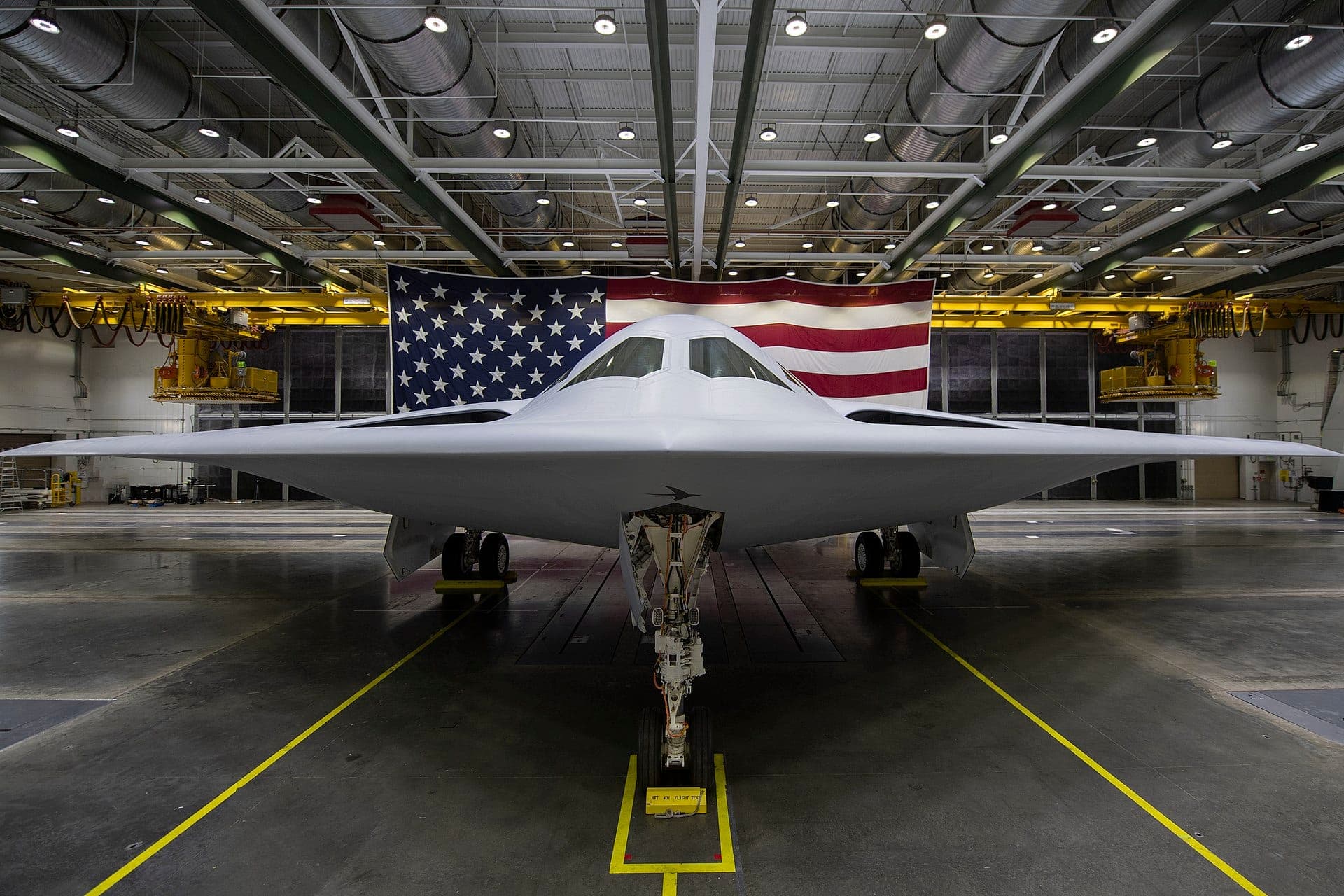
The B-21 Raider represents the future of American strategic airpower. As the first new bomber in over 30 years, it combines advanced stealth technology, modern networking capabilities, and the flexibility to deliver both conventional and nuclear weapons anywhere on Earth.

Next-Generation Stealth
While the B-2 Spirit pioneered stealth bomber technology in the 1980s, the B-21 advances every aspect of low-observable design. Northrop Grumman incorporated three decades of stealth research into the Raider's airframe.
The B-21's stealth goes beyond radar evasion. Engineers designed the aircraft to minimize infrared, acoustic, and electromagnetic signatures. Advanced coatings and materials technology make the Raider harder to detect across the entire threat spectrum.
Penetrating Defended Airspace
Modern air defense systems present unprecedented challenges. Russia's S-400 and China's HQ-9 systems can detect and engage aircraft at extreme ranges. The B-21 was designed specifically to penetrate these threat environments.
Key capabilities include:
- Advanced electronic warfare: Integrated systems to jam and deceive enemy radars
- Sensor fusion: Multiple sensors provide comprehensive situational awareness
- Adaptive flight planning: Ability to adjust mission profiles based on real-time threat data
- Low-observable design: Every surface optimized to minimize detection
Nuclear and Conventional Flexibility
The B-21 serves as a dual-capable bomber. It can deliver nuclear weapons as part of America's strategic triad or carry conventional precision munitions for conventional conflicts.
Planned weapons include:
- B61-12: Nuclear gravity bomb with precision guidance
- LRSO: Long Range Stand-Off nuclear cruise missile
- JASSM-ER: Joint Air-to-Surface Standoff Missile Extended Range
- GBU-57 MOP: Massive Ordnance Penetrator for hardened targets
Network-Enabled Operations
Unlike the B-2, designed in an era of limited data connectivity, the B-21 incorporates modern networking from the ground up. The Raider can share targeting data, receive updated intelligence, and coordinate with other platforms in real-time.
This connectivity transforms the B-21 from a simple bomb truck into a sensor node and command platform. It can gather intelligence, relay information to other aircraft and ground forces, and adapt to changing battlefield conditions.
Cost and Production
The Air Force set aggressive cost targets for the B-21:
- Unit cost target: $550 million (base year 2010 dollars)
- Current estimated unit cost: $692 million (base year 2022 dollars)
- Planned procurement: At least 100 aircraft
Compared to the B-2's $2+ billion per aircraft, the B-21's cost discipline represents a significant achievement. Northrop Grumman designed the aircraft with manufacturability in mind, avoiding the production challenges that limited B-2 quantities.
The Raider Name
The Air Force named the B-21 "Raider" in honor of the Doolittle Raiders who struck Japan in April 1942. That mission demonstrated America's ability to project airpower across vast distances. The B-21 continues that legacy with global reach capabilities.
Strategic Impact
The B-21 ensures American bomber capability for decades to come. As the B-1 and B-2 age, the Raider will become the backbone of the bomber fleet, maintaining the ability to hold any target on Earth at risk.
For comparisons with other American bombers, see our analysis of the B-1 vs B-2 differences.